

Practical Plant Growth Analysis Galangal Plastochron

Updated: Oct 18
1. Introduction
Growth analysis is a mathematical expression of environmental effects on the growth and development of crop plants. Classical growth analysis typically requires the destructive harvesting of representative sets of plants over several weeks, making it impossible to follow the same plant throughout an entire experiment.
This practical introduces a non-destructive, single-harvest alternative by utilizing a space-for-time substitution. By examining a single frond of galangal (Alpinia galanga), we can observe leaves at different developmental stages on the same plant. Because leaves emerge sequentially from the shoot apex at regular time intervals (the plastochron), the spatial position of a leaf along the stem directly correlates with its chronological age. The topmost leaf is the youngest, and the lowest leaf is the oldest.
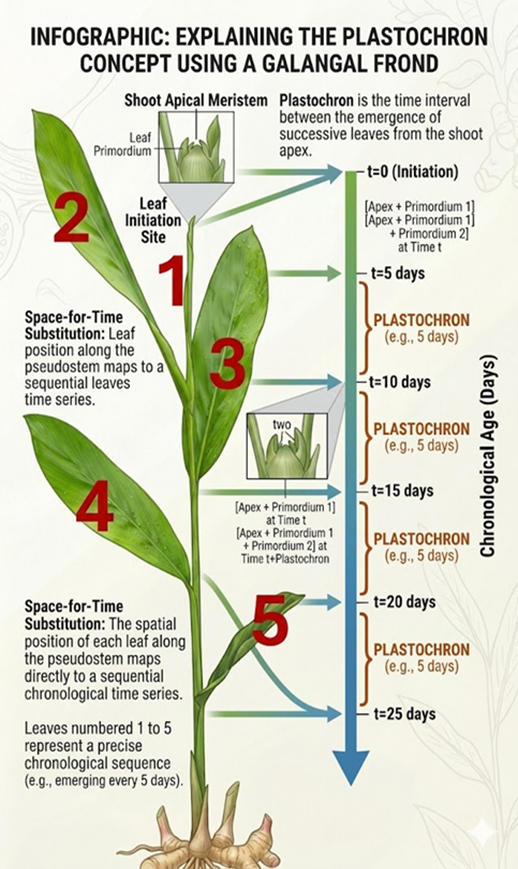
2. Theory
Plant growth is a quantitative, irreversible increase in size, mass, or cell number. The typical growth pattern of a plant follows a sigmoid curve, divided into three main phases:
i. Lag phase: Initial stage where the growth rate is quite slow.
ii. Log or exponential phase: Growth rate is at its maximum due to rapid cell division and physiological processes.
iii. Stationary/Senescence phase: Growth is almost complete and becomes static, with the growth rate approaching zero.

Using the differences in leaf area and leaf dry weight between adjacent leaves on the stem, we can calculate four fundamental growth indices.
Formula Variable Legend (READ CAREFULLY)
Because we are comparing leaves chronologically down the stem, 1 always refers to the younger, upper leaf, and 2 refers to the older, lower leaf.
• W1 = Dry weight of the younger leaf in grams (g)
• W2 = Dry weight of the older leaf in grams (g)
• T1 = Assumed age of the younger leaf in days (day)
• T2 = Assumed age of the older leaf in days (day) (Note: The time interval T2 - T1 will always be 5 days for this practical).
• A1 = Leaf area of the younger leaf in square centimetres (cm²)
• A2 = Leaf area of the older leaf in square centimetres (cm²)
• A = Specific Ground Area. For this practical, assume each galangal shoot occupies a ground area of 0.01 m² (which is 100 cm²).
• ln = Natural Logarithm (loge). Use the "ln" button on your scientific calculator.
The Growth Formulas
• Absolute Growth Rate (AGR): The rate of increase in dry matter, indicating the total growth of the plants. AGR = (W2 - W1) / (T2 - T1) [Unit: g/day]
• Relative Growth Rate (RGR): The rate of increase in dry matter per unit of existing dry matter, indicating the proportionate growth of the plant independent of its size. RGR = (ln W2 - ln W1) / (T2 - T1) [Unit: g/g/day]
• Crop Growth Rate (CGR): The rate of increase in dry matter per unit ground area, indicating the dry matter production capacity per unit area. CGR = (W2 - W1) / [A (T2 - T1)] [Unit: g/m²/day]
• Net Assimilation Rate (NAR): The rate of increase in dry matter per unit leaf area, indicating the assimilatory capacity of the plant. NAR = [(W2 - W1) / (T2 - T1)] [(ln A2 - ln A1) / (A2 - A1)] [Unit: g/cm²/day]
3. Objectives
i. To identify spatial and temporal integration of plant processes using a constant plastochron interval.
ii. To calculate AGR, RGR, CGR, and NAR using primary values (dry weights).
iii. To construct a sigmoid growth curve to know how the rate of dry matter accumulation varies across the life cycle.
4. Materials
• 1 Galangal frond per group (standardised to exactly 5 intact leaves)
• Leaf area meter (or digital scanner)
• Scissors / secateurs
• Paper envelopes or bags
• Analytical balance
• Drying oven (set to 50°C)
5. Methodology
Day 1: Fresh Measurements
i. Obtain one galangal frond with exactly 5 healthy leaves.
ii. Label your paper bags 1 through 5.
iii. Designate the topmost (youngest) leaf as Leaf 1 and the lowest (oldest) leaf as Leaf 5.
iv. Carefully excise each leaf at the collar.
v. Determine the Leaf Area (A) for each of the 5 leaves using the provided leaf area meter. Record this in Table 1.
vi. Place each leaf into its corresponding labeled paper bag.
vii. Place all bags into the drying oven set at 50°C. Leave them to dry for exactly one week.
Day 7: Dry Weight Measurements & Calculations
i. Remove the paper bags from the oven.
ii. Using the analytical balance, weigh each leaf to determine its Dry Weight (W). Record this in Table 1.
iii. Complete the data calculations in Table 2 using the formulas provided in the Theory section.
6. Data Tables
Table 1: Raw Morphological Data (Assume a constant plastochron interval of 5 days.)
Leaf Position | Assumed Age (T) | Leaf Area, A (cm²) | Dry Weight, W (g) |
1 (Top / Youngest) | 5 days |
|
|
2 | 10 days |
|
|
3 | 15 days |
|
|
4 | 20 days |
|
|
5 (Bottom / Oldest) | 25 days |
|
|
Table 2: Growth Parameter Calculations (Ground Area A = 0.01 m²)
Growth Interval | Time Interval | AGR (g/day) | RGR (g/g/day) | CGR (g/m²/day) | NAR (g/cm²/day) |
Leaf 1 to 2 | 5 days |
|
|
|
|
Leaf 2 to 3 | 5 days |
|
|
|
|
Leaf 3 to 4 | 5 days |
|
|
|
|
Leaf 4 to 5 | 5 days |
|
|
|
|
7. Expected Results & Discussion Points
1. The Sigmoid Curve: Plot the Assumed Age (x-axis) against Dry Weight (y-axis). You should observe a classic S-shaped curve, identifying the lag phase, the log/exponential phase, and the stationary phase.
2. AGR & CGR Dynamics: AGR and CGR are expected to peak during the log phase, where the plant experiences the maximum rate of dry matter accumulation, and decline as the leaf enters the senescence period.
3. RGR Dynamics: RGR is dynamic, typically starting high and then declining over the life cycle as plants grow and self-shade. It is highest in the younger tissues (Leaf 1 to 2) and declines over time, reflecting a drop in the plant's proportional growth as it increases in size.
4. NAR Dynamics: NAR typically decreases in the older leaves. This reflects a drop in assimilatory capacity, often due to self-shading and senescence in the lower canopy.
Manual PDF can be downloaded here:
Lab Report Samples:


Comments for Group IMUT PEOPLE: (Marks: 14/20)
(1) The cover page omits the department name. (lines 1–5) While the Faculty of Agriculture, subject code, subject name, and lecturer name are all present, there is no line identifying the Department of Crop Science. You need to add "DEPARTMENT OF CROP SCIENCE" between the faculty name and the subject code to ensure the cover page is complete.
(2) The cover page heading reads "TITLE : PLANT GROWTH ANALYSIS GALANGAL PLASTOCHRON" rather than the standard "PRACTICAL 1" or equivalent practical identifier. (line 4) Other groups' reports in this cohort use the format "PRACTICAL [number] : [topic]" on the cover page. You should verify with your lecturer whether this heading format is acceptable or whether it should follow…
Comments for Group Veronica: (Marks: 14/20)
The table of contents heading is missing the word "TABLE OF CONTENTS" and uses an incorrect singular heading for the results section. (line 20) The page heading reads only "CONTENTS NO.PAGE" rather than "TABLE OF CONTENTS." Additionally, the results section is listed as "5.0 RESULT" rather than "5.0 RESULTS," and this singular form is carried through to the actual section heading at (line 111). You need to correct both instances to read "5.0 RESULTS."
The Abstract is written in a mix of present and future tense rather than consistently in past tense, and it does not include any actual numerical results from the experiment. (lines 22–36) Phrases such as "students track structural and biomass distribution" (line 31), "The…
Comments for Group Power Rangers: (Marks: 14/20) --> (17/20)
Resubmission: ❌ Issues Still Not Fixed
Line 97 — Heading still reads "MATERIALS & METHODS"Should be "MATERIALS AND METHODS" — ampersand not corrected.
Plastochron interval formula — not shown how 5 days was derived The formula is now stated, but there is no explanation of how the value of 5 days was arrived at or confirmed for this specific plant. Still required.
Methods — leaf area measurement step missing Step 3 describes excising and drying leaves. Step 4 shows a photo of the leaf area meter machine but the description says "weighed using an analytical balance." The leaf area measurement procedure using the LI-3100C is still not explicitly described in a…
Marks Summary:
Comments for Sunflower Submission: (Marks: 17/20)
Line 78 (Table 1 — Leaf 1 Area Anomaly): There is a critical data recording concern in Table 1. Leaf 1 shows a leaf area of only 2.70 cm², while Leaf 2 jumps to 468.54 cm². This represents a 170-fold difference between two adjacent leaves, which is biologically implausible. It is highly likely this is a decimal point recording error, and the true value should be 270 cm². This single error has a cascading effect — it directly distorts your AGR, RGR, CGR, and NAR calculations for the Leaf 1 to 2 interval and makes your NAR value of 0.004213 g/cm²/day unreliable. You must verify your raw measurement and correct this before the calculations can…