

Practical-Auxin: Investigating Root Initiation in Alternanthera sissoo (Bayam Brazil)

Updated: Apr 22
Introduction & Theory
Plant propagation through stem cuttings is a fast and cost-effective technique that maintains the genetic traits of the parent plant. The success of this method depends heavily on the rapid formation of adventitious roots. This process is regulated by plant hormones called auxins, which stimulate cell division in the stem's vascular tissues.
Indole-3-butyric acid (IBA) is a widely used synthetic auxin because of its stability and effectiveness across many plant species. By applying different concentrations of IBA, we can observe its dose-dependent effect on rooting and determine the optimal concentration for propagating Alternanthera sissoo (bayam brazil).
Aim
To determine the influence of different concentrations of Indole-3-butyric acid (IBA) on the rate of root emergence and root elongation in stem cuttings of Alternanthera sissoo over a 14-day period.
Materials (Per Group)
Healthy Alternanthera sissoo (bayam brazil) mother plant
Secateurs or sharp scissors
Ruler (to measure cutting lengths and root lengths)
1 labelled glass beaker or hydroponic container
Fresh water
1 assigned Indole-3-butyric acid (IBA) solution: 0 mg/L (Control), 25 mg/L, 50 mg/L, 75 mg/L, 100 mg/L, OR 150 mg/L
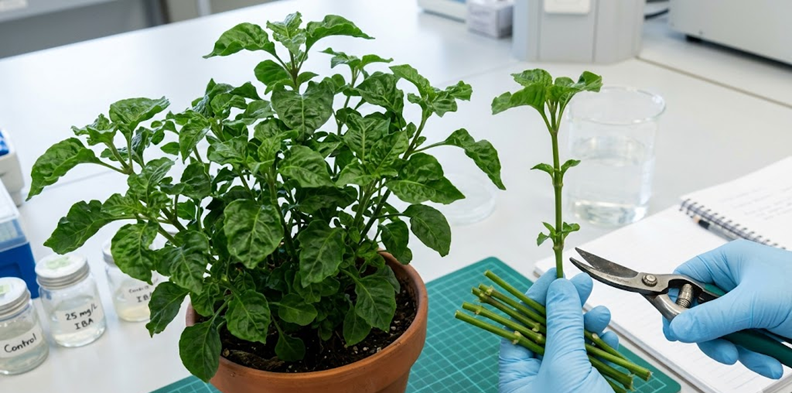
Method
1. Your group will be assigned one specific IBA concentration for this experiment.
2. Using sharp scissors, take 5 healthy shoot cuttings from the A. sissoo plant.
3. Ensure each cutting has at least 3 to 4 nodes.
4. Trim each cutting to a uniform length of exactly 5 cm, removing the lower leaves to prevent rotting in the solution.
5. Pour your group's assigned IBA solution into the labelled beaker.
6. Place the 5 stem cuttings into the beaker, ensuring the bottom nodes are fully submerged in the solution.
7. Leave the cuttings in a well-lit room (avoiding direct, harsh sunlight) for 14 days.
8. Observation 1 (Day 7): Carefully remove the cuttings. Count the total number of visible roots per cutting and measure the length of the longest root (in cm). Record the data and gently return the cuttings to the beaker.
9. Observation 2 (Day 14): Repeat the counting and measuring process. Calculate the average root number and average root length for your specific concentration.
10. Data Pooling: Share your group's Day 7 and Day 14 averages on the main class whiteboard or shared spreadsheet so all groups can complete their full dataset.
Class Data Collection Table
IBA Concentration (mg/L) | Day 7: Avg. Root Count (per cutting) | Day 7: Avg. Root Length (cm) | Day 14: Avg. Root Count (per cutting) | Day 14: Avg. Root Length (cm) |
0 (Control) | ||||
25 | ||||
50 | ||||
75 | ||||
100 | ||||
150 |
Note: To calculate the average for your group, add the values of all 5 cuttings and divide by 5.
Graph & Interpretation
How to Plot Your Graphs You will need to plot two separate curves using the pooled class data to fully understand the effects of the auxin:
Graph 1: Root Emergence. Y-axis: Average Number of Roots (Day 14). X-axis: IBA Concentration (mg/L).
Graph 2: Root Elongation. Y-axis: Average Root Length in cm (Day 14). X-axis: IBA Concentration (mg/L).
Interpretation for Students
The Control (0 mg/L): Shows the natural rooting ability of A. sissoo without hormonal stimulation.
The Upward Curve: As IBA concentration increases, you should generally see an increase in both root count and root length, showing a positive dose response to the auxin.
The Peak / Plateau (Optimal Point): The graph will eventually peak. This represents the optimal IBA concentration for propagating bayam brazil.
The Decline (Toxicity): If the concentration becomes too high (e.g., potentially at 75 mg/L, 100 mg/L, or 150 mg/L), root formation and length may drop sharply. This indicates that excessive auxin causes hormonal stress or acts as an inhibitor to the plant tissues.
Summary of Changes:
Added 150 mg/L: Added the new concentration to the Materials list, the Data Table, and the Interpretation section.
Adjusted Materials for Group Scale: Changed the materials list to reflect what a single group needs (e.g., 1 beaker instead of 5, 1 assigned IBA solution instead of all of them).
Updated Methodology for Collaboration: Rewrote the methods so each group only prepares 5 cuttings for their single assigned concentration.
Added a Data Pooling Step: Inserted "Step 10" in the method, explicitly instructing students to share their calculated averages with the rest of the class to fill out the overarching table.
Clarified Graph Instructions: Added a note specifying that the graphs should be plotted using the "pooled class data" rather than just their own group's data.
USE THIS EXCEL TO SHARE ALL OF YOUR DATA:Class Data Pool_ Auxin Root Initiation 22APRIL2026.xlsx
Manual in PDF:
Sample report as follows:


Comments for Group Imut People: Marks10/20 1st-Submission:
The Discussion (lines 220–223, 240–244) cites Raven et al. (2005) and Ali et al. (2012) with claims that appear fabricated or overstated beyond what these general plant-biology/jojoba-rooting textbooks and papers would support — e.g., attributing to Raven et al. a specific claim about "certain easy-to-root species" maintaining synchronised dual-growth hormone stores, and to Ali et al. a general claim about "standard quadratic dose-response curves." You need to verify these citations actually support the specific claims made, or rephrase to reflect only what the sources demonstrate.
The Discussion states the 75 mg/L treatment "exceeded the cellular tolerance threshold" and induced "physiological resistance" and describes 150 mg/L as causing "over-production of internal ethylene gas which halts…
Comments for Group Matcha Latte: 12/20
Materials/Methods (line 87) — states "10mL of IBA solution... was prepare" — should read "was prepared."
Materials section (lines 80–84) — missing a ruler (used later in Methods to measure root length) and tap water from the Materials list; you should add these.
Units inconsistency (lines 106, 126, 176–201) — Tables 4.1 and 4.2 report root length in mm, while the summary graphs (Graph 4.2) report averages in cm; this switch is not explained or converted transparently in the text.
Line 233 — "5,720cm" contains a comma instead of a decimal point; should be "5.720 cm" (or similar) — a typographical error.
Line 251 — "Alternanthera sissoonaturally" is missing a space between "sissoo" and…
Comments for Group Ubi Kayu: 15/20
The species name is misspelled as "Alternanthera sisso" (missing the second "o") in the title on the cover page (line 8), and again as "Althernanthera" (letters transposed) throughout the Materials, Results, and figure captions (e.g., lines 102, 103, 119, 125–126, 135–136, 150, etc.). The correct spelling, "Alternanthera sissoo," should be used consistently.
The Abstract describes only five concentrations (0, 25, 50, 75, 100 mg/L) and frames this as the full experimental design (lines 18–20), but the actual class dataset used in the Results includes six concentrations, up to 150 mg/L (see Table 4.1, line 137). The Abstract should reflect the complete design actually analyzed in the Results section, including the 150 mg/L treatment and…
Comments for Group Power Rangers: 15/20
The Abstract describes replicates and IBA concentrations as if this group tested all six themselves, but the design is one concentration per group with class-pooled data. It should clarify that this group's own primary data covers only their assigned concentration (50 mg/L), with the rest drawn from other groups (line 19).
The Materials list only includes two items (stem cuttings and IBA solution, plus scissors and a beaker) — it omits apparatus clearly used and shown in the figures, such as the ruler and labels/marker pen. These should be added with full specifications (lines 89–94).
The Results table uses group nicknames ("Imut People," "Matcha Latte," "Power Ranger," "Ubi Kayu," "Veronica") as the primary…
Comments for Group SUNFLOWER: 18/20
Materials list (Section 3.1) omits quantities/specifications — no stated volume of IBA solution or beaker capacity is given, only generic item names (page 5 table, lines 64–65 area).
The 150 mg/L treatment shows all cuttings at 0 for both root count and root length on Day 7 and Day 14, indicating complete cutting death, but the report never states this — the Discussion and Conclusion describe this only as "no root formation" or growth being "inhibited," not as mortality. This should be explicitly identified as cutting death, not merely suppressed rooting (lines 140–141 data; discussion at lines 213–215; conclusion at lines 233–235).
In-text reference "Hopkins and Hüner (2008)" — the reference list entry renders as…